Biography
S. Joshua Swamidass, MD PhD, is an Associate Professor of Pathology & Immunology in the Division of Laboratory and Genomic Medicine at Washington University School of Medicine in St. Louis, with appointments in Biomedical Engineering and in Computer Science & Engineering. His research develops artificial intelligence for problems in biology, medicine and chemistry, with a focus on tools that directly affect drug safety and patient care.
He is best known for deep learning models of bioactivation, the process by which the body metabolizes some medicines into toxic forms. Supported by the National Institutes of Health, this work produced the XenoSite family of models, which are used by pharmaceutical companies to guide the development of safer medicines. More recently his group has developed AI for pathology practice and was among the first academic groups to deploy AI into a pathology workflow. A deep learning model for assessing donor kidney biopsies, developed with Joseph Gaut, is licensed to Trusted Kidney and is now used in clinical practice to help transplant more donated kidneys. He also founded ReMedical to commercialize the bioactivation models.
He trained in computer science and medicine at the University of California, Irvine, earning a BS in biology, an MS and PhD in Information and Computer Sciences under Pierre Baldi, and an MD. After residency in clinical pathology at Washington University, and visiting appointments at the Broad Institute of MIT and Harvard and at Pfizer, he joined the Washington University faculty in 2010. He has mentored PhD students, postdoctoral fellows, residents and junior faculty, and teaches population genetics and AI for image analysis in pathology.
In 2023 he was elected a Fellow of the American Association for the Advancement of Science (AAAS), for “distinguished contributions to the field of deep learning in computational biology, and for extraordinary public outreach promoting an understanding of science among communities of faith.”
Public engagement with science
The outreach recognized by the AAAS focuses on explaining evolutionary science, human origins, race and artificial intelligence to public audiences, especially communities that are often skeptical of scientific findings. He has given plenaries, named lectures and invited talks at universities and conferences including MIT, Cambridge, Oxford, Emory and New York University. His writing has appeared in Science, Nature, The Wall Street Journal and Christianity Today, and his work has been covered by WIRED,USA Today and NPR. An archive of his essays and public dialogues is kept at Peaceful Science.
Book
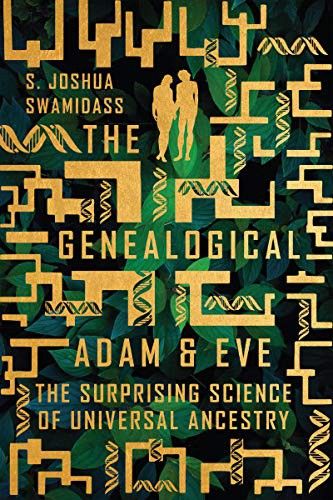
The Genealogical Adam and Eve: The Surprising Science of Universal Ancestry
IVP Academic, 2019 · Wikipedia
The book explains the difference between genetic and genealogical ancestry, a distinction that is often overlooked in public discussions of human origins. Drawing on population genetics and computational models of genealogy, it shows how everyone alive today shares common genealogical ancestors who lived surprisingly recently, even though our genetic ancestry traces back to a large population over a much longer time. The book also explains the scientific problems with polygenesis, the discredited claim that human races arose separately, which historically supported racist ideas about inherent racial differences.
Peer reviewed and published by an academic press, the book has sold more than 10,000 copies and was endorsed by scientists including population geneticist Alan Templeton.
Articles and reviews
- The End of Evolution? (with Nathan H. Lents and Richard E. Lenski) Science 363(6427), 2019. Review of Michael Behe’s Darwin Devolves.
- Advancing Evolutionary Science in Dialogue with Islam Theology and Science 21(4):642–659, 2023
- The Overlooked Science of Genealogical Ancestry Perspectives on Science and Christian Faith 70(1):19–35, 2018
- Initiatives to bridge faith and science Nature 523:531, 2015 (correspondence)
Reception of the book
- Author-meets-critics session, American Academy of Religion and Society of Biblical Literature Annual Meeting 2020. Panel included biologist Kenneth R. Miller (Brown University) and scholars of theology and biblical studies.
- Nathan H. Lents, biologist (John Jay College, CUNY), USA Today 2019. “It just might allow those who do believe to be more open to evolution and, god willing, to science more broadly.”
- Reviewed in Reviews in Religion & Theology 27(4), 2020
Public writing
- Setting Our Scopes on Things Above Christianity Today, May/June 2025. On the centennial of the Scopes trial, and how the way the evolution controversy was handled has shaped public understanding of science for a century.
- A Compromise on Creationism The Wall Street Journal, March 2021. On how accreditation can handle creation science transparently.
- The Lesson of Kitzmiller: Science Bridges Divides (with Nathan H. Lents) St. Louis Post-Dispatch, December 2020. On the 15th anniversary of the Dover intelligent design ruling.
- Evangelicals Take On Artificial Intelligence The Wall Street Journal, May 2019. An AI researcher’s response to a religious statement of principles on AI.
- Rubio and the Age-of-the-Earth Question The Wall Street Journal, 2012. Argues that the age of the Earth and evolution belong in science classrooms, not in political or religious controversy.
- A New Bargain for Drug Approvals (with Michele Boldrin) The Wall Street Journal, July 2011
Service and public dialogue
- Science Advisor, AAAS Science for Seminaries program Concordia Seminary, St. Louis, 2015–2017
- Science Advisor, “Scripture and Science: Our Universe, Ourselves, Our Place” Exhibit at the Museum of the Bible, Washington, DC, 2019–2023
- Advisory Board, Consortium for Advancing a Science of Purpose (CASP) Minnesota Center for Philosophy of Science, University of Minnesota, 2025–present. CASP, directed by philosopher of biology Alan C. Love and funded by the John Templeton Foundation, brings together philosophers, theoreticians and experimentalists to study agency, directionality and goal-directedness in living systems. As one of eight scientific advisors, he helps guide the consortium’s research program, workshops and fellowships, contributing a computational and biomedical perspective.
- Public dialogue on evolution and human origins with biologist Nathan H. Lents University of North Carolina at Chapel Hill, 2022
In the media
- How 2 St. Louisans Are Refining Contemporary Understandings of Race, Racism St. Louis Public Radio, June 2020
- What does science tell us about Adam and Eve? The Source, Washington University, June 2020
- Wash U’s Dr. Joshua Swamidass Builds Bridge Between Science and Creation Myths in New Book St. Louis Public Radio, December 2019
- America’s Clergy Are Teaming Up With Scientists WIRED, October 2018. On the AAAS Science for Seminaries program and his work at Concordia Seminary.
Selected invited talks
- Plenary, Computer Aided Drug Design Gordon Research Conference 2023
- AI and Chemistry, Department of Mathematics, Iowa State University 2023
- Applying AI in Chemistry, Biology, and Medicine Southern California AI & Biomedicine Symposium, UC Irvine, 2022
- Deep Learning the Bioactivation of Drugs Division of Chemical Toxicology, American Chemical Society, 2022
- Translating from Chemistry to Clinic with Deep Learning National Institutes of Health, 2018
- Plenary, International Biocuration Conference Fudan University, Shanghai, 2018
- Plenary, Chemical Biology Workshop University of Minnesota, 2018
- Of Apes and Artificial Minds, McDonald Lecture Hong Kong University, 2017
- Plenary, Gordon Research Conference Exploring Advances in Quantitative Predictions of Drug Metabolism, Transport, Safety and Pharmacokinetics, 2017
- Machine Learning of Drug Metabolism CADD Forum, Janssen Research & Development, 2016
Research in the news
- Artificial Intelligence Shakes Up Drug Discovery The Scientist, 2019
- Tracking where the O’s go ACS Central Science, 2015. Commentary on the epoxidation model.
- Cryptographic methods enable analyses without privacy breaches Nature Medicine, 2014
Lab alumni
- Tyler B. Hughes, PhD, 2018 AI scientist in industry
- Na Le (Lena) Dang, MD PhD, 2018 Physician-scientist, pediatrics, WashU
- Matthew K. Matlock, MD PhD, 2019 Emergency medicine
- Arghya Datta, PhD, 2021 Scientist, Amazon
- Noah R. Flynn, PhD, 2021 Scientist, pharmaceutical industry
- Kathryn Sarullo, PhD, 2023; postdoc, 2023–2025 Research scientist
- Jed Zaretzki, Postdoc, 2012–2013 Computational scientist, biotech
- Rohit Farmer, Postdoc, 2018–2019 NCBI, National Institutes of Health
- Jon N. Marsh, Staff scientist, 2017–2023 Industry scientist